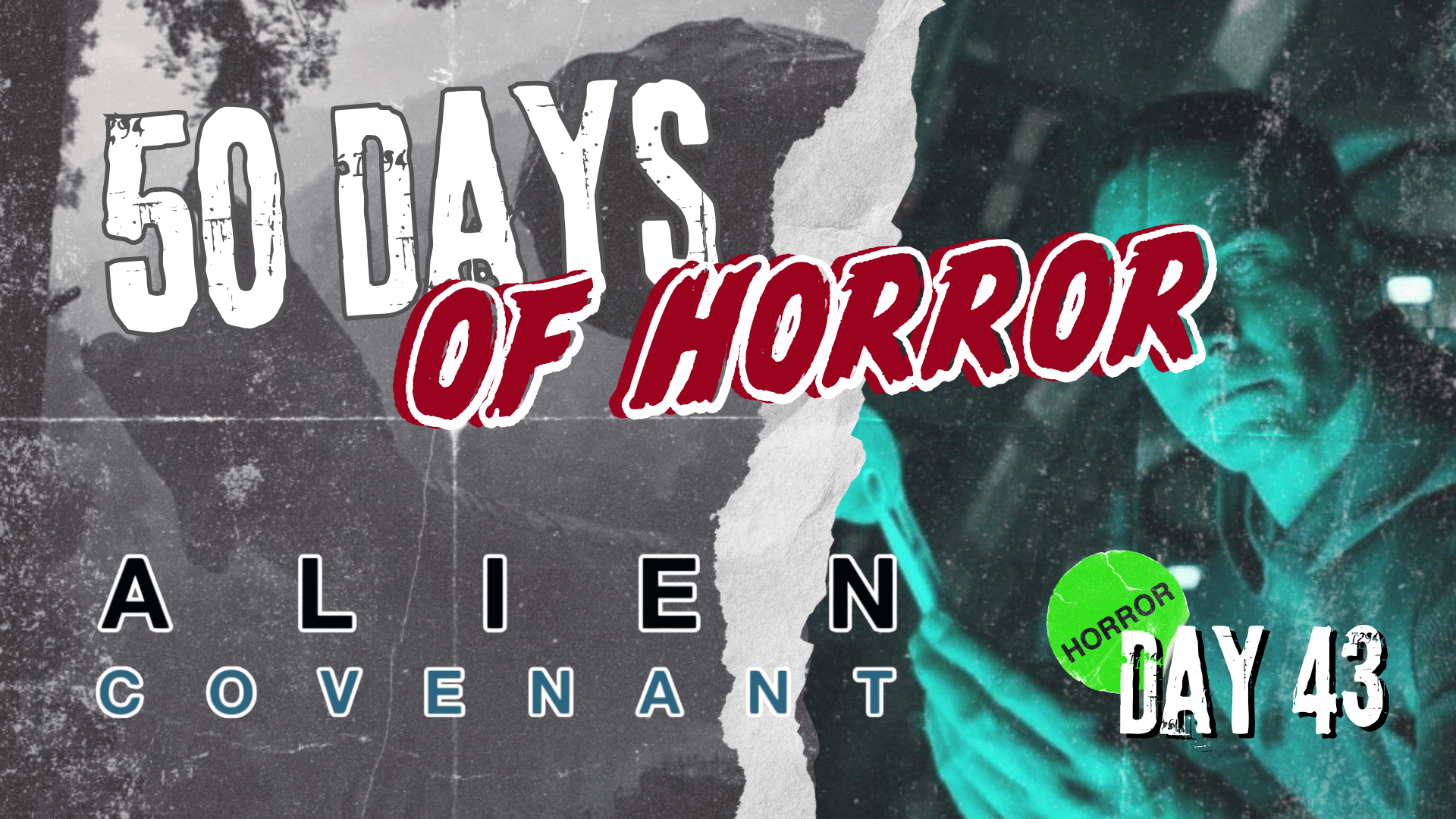
Alien: Covenant (2017) | 50 Days of Horror, Day 43
Day 43 of 50 Days of Horror: Ridley Scott's Alien: Covenant is a divisive, gothic, creature-feature-meets-creation-myth that sits between Prometheus and the original Alien, and it's stranger and more ambitious than its reputation.

Alien: Covenant is the franchise's awkward middle child. It's a sequel to Prometheus and a prequel to Alien, which means it has two sets of expectations pulling at it from opposite directions: one crowd wants the monster, the other wants the mythology. Ridley Scott, returning to the universe he launched in 1979, decided to give both of them a turn at the table. Some people have never forgiven him for it. I think that's exactly why it's worth a second look.
The setup will feel comfortable. A colony ship, a crew with a mission, a stray transmission that points toward a world that looks too good to ignore. Katherine Waterston plays Daniels, the crew member who, for a lot of the film, is the voice of caution. Billy Crudup, Danny McBride, Demián Bichir, Carmen Ejogo, and Amy Seimetz round out a crew that feels like an actual group of coworkers and couples rather than a lineup of future victims, which is part of why the film hurts when it starts taking people apart.
And take them apart it does. Scott is playing with a different kind of creature this time. The Neomorphs grow quickly inside crew members infected by spores from the planet's fungi, and the film wanted them to look organic and a little wrong. According to the production history, Scott deliberately steered away from H.R. Giger's biomechanical look, drawing on anatomical references from Florence's La Specola museum and a San Diego Zoo consultant. The Creature NFX workshop reportedly spent almost six months building animatronics, with performers wearing suits that had animatronic heads. That blend of physical presence and digital polish gives the monster scenes a wet, uncomfortable heft, even when they're brief.
The real fascination, though, is Michael Fassbender. He plays two androids: David, the unsettled creation left over from Prometheus, and Walter, a newer model built to be loyal and unimaginative. Watching one actor play both sides of the film's central argument is like watching someone hold a conversation with his own reflection, and it's the part of the film that most clearly justifies Scott's ambitions. David has looked at the people who built him and concluded that they're a rough draft. That's a sharper idea than most monster movies bother to ask, and it gives the film's cathedral-sized set pieces an ideology to go with the architecture. Cinematographer Dariusz Wolski and composer Jed Kurzel, who weaves in themes from Jerry Goldsmith's original Alien score, give it a sound and look that feel more like a gothic tragedy than a space truck horror movie.
The behind-the-scenes story is a little less tidy. Principal photography began on April 4, 2016, at Milford Sound in New Zealand and wrapped on July 19, with additional work at Leavesden Studios in England. Scott's first cut reportedly ran 2 hours and 23 minutes before being trimmed by more than twenty minutes. The film cost somewhere around $97 to $111 million, depending on the source, and earned about $240 million worldwide, a disappointment next to Prometheus's $403 million. Reviews were mildly positive, with a 65 percent score on both Rotten Tomatoes and Metacritic and a B from CinemaScore. Here's a funny footnote: the Chinese release reportedly ran about six minutes shorter, with most of the alien scenes trimmed and a kiss between Fassbender's two characters removed.
It also sits comfortably alongside other prequel experiments we've covered. If you've been following this countdown, you've seen the original Alien lay down the template, and The Thing (2011) take a swing at a prequel of its own. Covenant is a more philosophical cousin to both, and in 2024 the franchise went back to basics with Alien: Romulus, which sits between Alien and Aliens.
If a film this stately and strange gets under your skin, the Nightmare Logic line has the same kind of cold, high-contrast beauty: monochrome, sharp, and just distorted enough to feel like it was carved into the wall of an abandoned temple. It's for people who like their horror a little operatic.
So here's my question. Covenant asks whether it's more frightening to meet a monster or to meet the thing that made it. Which one stays with you longer, the creature in the dark, or the creator who thinks of it as art?
Part of the 50 Days of Horror series.