
A Quiet Place Part II (2021) | 50 Days of Horror, Day 47

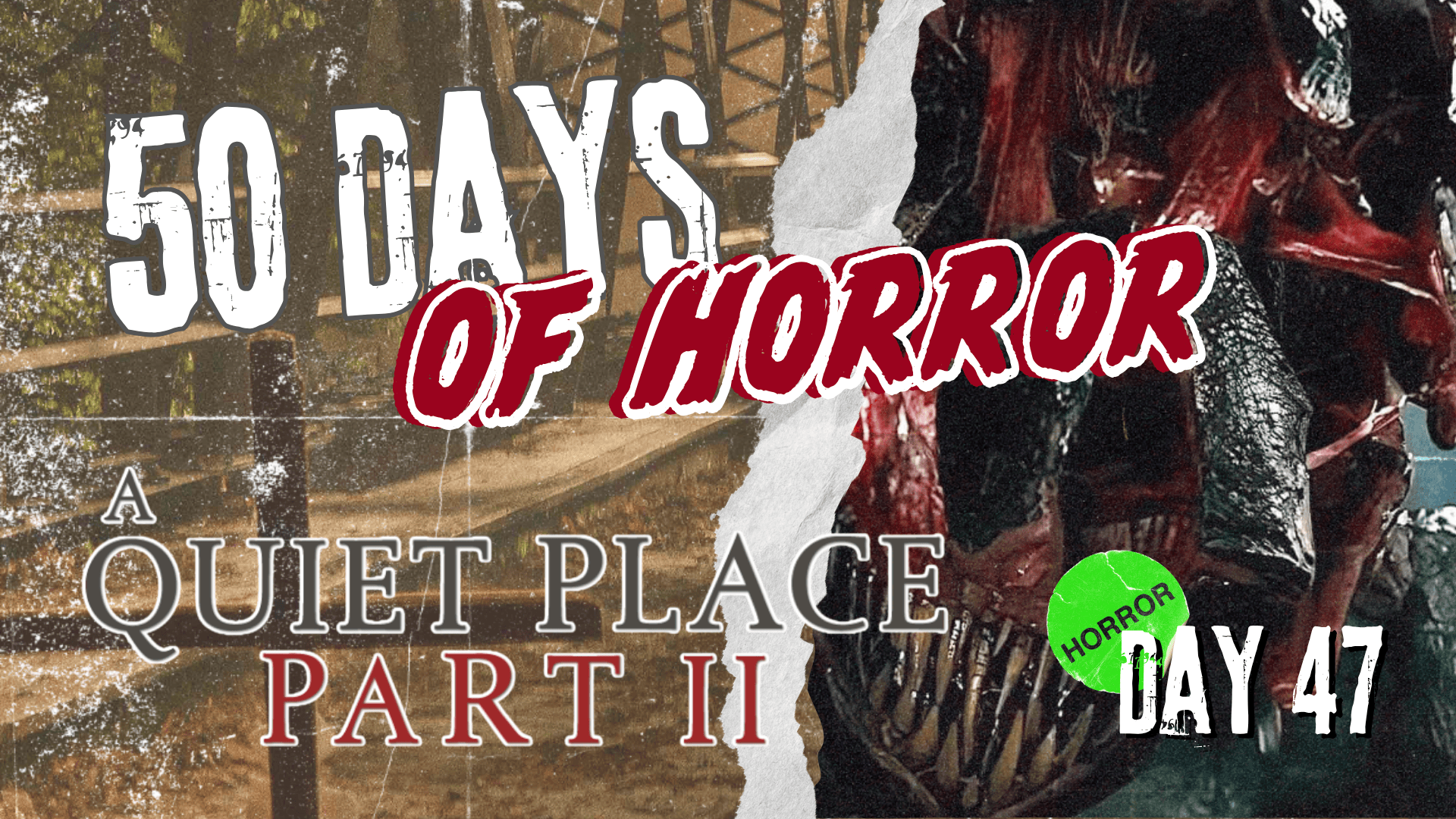
A Quiet Place Part II had to wait in silence of its own. It premiered at Lincoln Center in New York on March 8, 2020, and four days later, as the pandemic took hold, Paramount pulled it. Release dates came and went, shuffling through September 2020, April 2021, and more, until it finally reached theaters on May 28, 2021, as one of the first major studio releases to open after the world shut down. John Krasinski has said he wanted people to see it together, in a room, holding their breath at the same time, and that the moment wasn't right until it was. A film about the power of staying quiet had to be patient to get its audience back.
It's fitting, then, that this sequel is about what you do when the worst has already happened and you still have to keep moving. Krasinski wrote and directed, and the story picks up right where the first film left off, with the surviving Abbotts leaving their farm behind. But the part everyone talks about comes first: a prelude set on Day One, when a sunny small-town Little League game in Millbrook, New York, goes wrong. Krasinski has said he wanted the camera to always keep moving and to build the film from long, unbroken takes, and that approach turns the opening into a kind of miniature disaster movie. The Guardian's Peter Bradshaw singled out that prelude for praise, and it's easy to see why. It's the one stretch of the film where you can feel the whole world coming apart in a handful of unbroken takes.
What makes the sequel more than a replay is where Krasinski puts his focus. By his own account, his starting idea was to make Millicent Simmonds's Regan the lead, because "her character opens the door to all the themes I was dealing with in the first movie." Simmonds is deaf in real life, worked with an ASL coach, and has said she felt "a sense of pressure" to represent the deaf and hard-of-hearing community. The film earned the Ruderman Family Foundation's Seal of Authentic Representation for her portrayal, and you can feel why in how the story treats Regan's experience as the engine of the plot, not a gimmick. Without spoiling anything, the way her cochlear implant becomes central to the film's survival logic is one of the smartest ideas the series has had.
The rest of the cast fills in the edges. Emily Blunt returns as Evelyn, Noah Jupe is Marcus, and Cillian Murphy joins as Emmett, a lone survivor worn down by loss, who gives the film its sharpest moral question: is it worth helping people when helping is dangerous? Djimon Hounsou and Scoot McNairy round out the new faces, with Hounsou stepping in after Brian Tyree Henry left the project over scheduling. Krasinski himself appears as Lee in the Day One prelude, a gentle reminder of what the family lost.
Behind the camera, the film takes its look seriously. Polly Morgan took over as cinematographer from Charlotte Bruus Christensen and shot on 35mm film, using different Kodak stocks for night scenes and daytime exteriors. The sound team, which returned from the first film, was told to follow the rules the first movie had set, and they've said their goal was simply to make the audience hold their breath. That discipline pays off. Sound is the scariest thing in the film, and so is its absence.
The shoot ran about 47 days around Western New York, including Akron, Olcott, Dunkirk, Buffalo, and the abandoned Bethlehem Steel plant in Lackawanna, and a day when the South Grand Island Bridge was closed down for 13 hours. Yes, I noticed it's Day 47 and a 47-day shoot. I'll take the cosmic wink.
The critics were on its side. It scored 91 percent on Rotten Tomatoes and 71 on Metacritic, and CinemaScore audiences gave it an A−, up from the first film's B+. It reportedly cost somewhere around $55 to $61 million, more than three times what the first one did, and earned about $297 million worldwide. It also won the Critics' Choice Super Award for Best Horror Movie. A spin-off, A Quiet Place: Day One, followed, and Part III is currently slated for July 2027.
If you've been following this countdown, this is a nice palate cleanser after last night's blood-soaked Evil Dead. The first film, A Quiet Place, asked how you protect a family when a single sound can end it. The sequel asks the harder follow-up: what do you do with the rest of the world?
If a story that's all hush and held breath is your kind of horror, the Nightmare Logic line has the same minimalist nerve: monochrome, high-contrast, stripped down to the shape of the thing itself, with typography warped just enough to feel like a whisper in the wrong room.
So here's my question. A Quiet Place Part II argues that the person who has always lived with silence is the one best equipped to survive in it. Do you think the film's real hero is Regan, or the way the world finally learns to listen to her?
Part of the 50 Days of Horror series.