
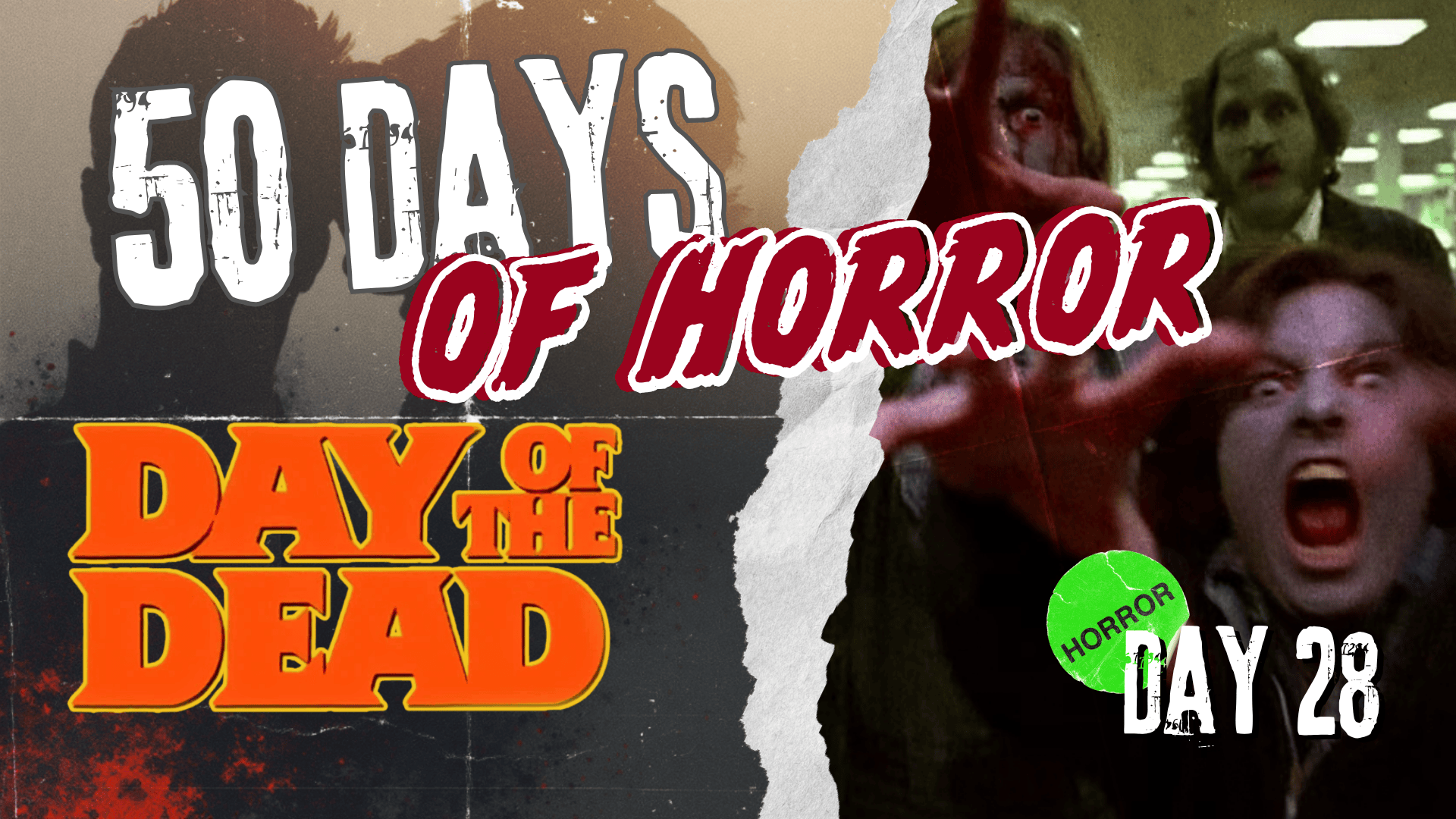
Day of the Dead (1985) | 50 Days of Horror, Day 28
Day 28 of 50 Days of Horror: George A. Romero's Day of the Dead began as a grand finale, got squeezed into a mine, and turned into the angriest and most human zombie film of the trilogy.

Day of the Dead opens inside a nightmare. Sarah is trapped in a small brick room, staring at a calendar with every day crossed out, and decayed arms punch through the wall to grab her. She wakes in a helicopter over a deserted Fort Myers, Florida, a bullhorn calls out across the empty streets, and the town answers back. It's a brilliant way to start a movie, because it tells you everything you need: the days are being counted, nobody is coming, and even the dreams have run out of room.
The funny thing is how close this film came to being something else. Romero has called his original idea the Gone with the Wind of zombie films, with a first script north of 200 pages and a budget in the neighborhood of $7 million. The money got cut roughly in half, the script shrank to an 88-page shooting draft, and the story got dragged underground, with the bunker scenes shot below the surface near Wampum, Pennsylvania. It's tempting to treat that as a compromise, but the squeeze turned out to be the best thing that could have happened to it. Cut off from sunlight, from space, from any reason to feel hopeful, the movie becomes a pressure chamber, and the pressure is where it does its best work.
What comes out of that pressure is mostly noise. There are a lot of loud people in this film, and most of them are wrong. Captain Rhodes, played by Joseph Pilato with a ferocity that borders on operatic, is a man who has confused volume with leadership, and the way he spits his orders makes every scene feel like a fuse being lit. Dr. Logan, the researcher everyone nicknames "Frankenstein," is calmer and somehow worse, because his certainty comes wrapped in curiosity. Between them is Sarah, played by Lori Cardille, who spends the whole movie being the only adult in the room. Her small pocket of warmth is a Winnebago parked near the barricades, run by the helicopter pilot John (Terry Alexander) and the radio operator Bill McDermott (Jarlath Conroy), who call it the Ritz. It's some of the most underrated stuff in the series. After all the shouting, there's a room where drinks get poured, the mood is oddly Caribbean, and John calmly tells Sarah the research is hopeless and she should get out while she can. It feels like oxygen.
And then Bub walks in, and the movie changes shape. Sherman Howard plays him with so much patience that you stop noticing the makeup. Logan reintroduces him to everyday things, a razor, books, a tape player, and Bub gives a salute that's clearly muscle memory from another life, so what you're watching is a dead man trying to remember how to be a person. He's the funniest thing in the movie and the saddest, and when he finally picks up a gun, the film makes it clear whose side Romero is really on: the living may be the monsters here, but the dead haven't forgotten loyalty. The film's cruelest joke is that the most hopeful character is the one who's already gone.
None of this would land half as hard without Tom Savini's work. The effects in Day of the Dead belong in a museum of what hands can build. Every wound has weight, every torn body looks like it came out of something real, and the finale, with its mob of the dead finally getting its due, is a feat of controlled mayhem that CGI has never quite replicated. You can sense the labor in it. Somebody sculpted each of those bodies, rigged each of those squibs, and knew exactly how long the camera would linger.
The movie doesn't leave you in the dark, either. After the carnage, it lets Sarah, John, and Bill land on a tropical island, with sunlight and water where there used to be concrete. It's a small, odd note of grace in a film that's otherwise spent most of its runtime dismantling every kind of comfort, and it's why the movie sticks to you long after the credits.
If you're hunting for a copy, the thing to protect is the dark. So much of the film lives in tunnels and mine shafts, and a transfer that crushes the blacks into gray flattens the geography of the place, so look for a restoration that keeps the grain and keeps the shadows open. It's one of those films that really wants the lights off.
Here's what I keep chewing on: the first two films give you a reason to hope, and this one quietly takes it away, and yet it's the one where a dead man shows more loyalty than anyone in the bunker. Is that the bleakest ending in the trilogy, or the kindest?
Part of the 50 Days of Horror series.